The Sounds of French: Phonetic and Prosodic Challenges for Spanish Speakers
Published on 29 June, 2025 by Mylene in Phonetic ▪
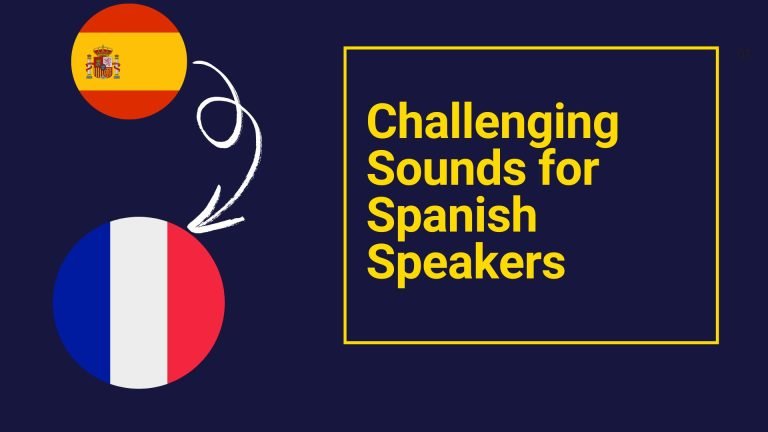
For a Spanish speaker learning French, certain sounds and aspects of French pronunciation can be challenging due to phonetic differences between Spanish and French. Here are the 13 most difficult pronunciation points, accompanied by explanations:
- Nasal vowels [ɑ̃] [ɛ̃] [ɔ̃]
- The sound [y]
- The sound [ʁ]
- The distinction between [e] and [ɛ]
- The pronunciation of the vowel e
- The sounds [ʒ] and [ʃ]
- The sound [z]
- The sound [b]
- The sound [œ]
- Stress accent
- Intonation
- Silent consonants
- Liaison and enchaînement
Nasal vowels [ɑ̃] [ɛ̃] [ɔ̃]
In Spanish, nasal vowels do not exist. Sounds like those in pain ([pɛ̃]), bon ([bɔ̃]), or dans ([ɑ̃]) are difficult to produce and distinguish for Spanish speakers, who may confuse them with oral vowels like a or o. It’s also important not to pronounce the [n].
The sound [y]
The sound of the letter u in French, as in lune ([lyn]), is unique and does not exist in Spanish. Spanish speakers tend to replace it with the sound [u] (as in luna in Spanish).
The sound [ʁ]
The French r, guttural and produced in the throat (as in rouge), is very different from the rolled or vibrant r in Spanish. Spanish speakers may struggle to produce this sound and replace it with a rolled r.
The distinction between [e] and [ɛ]
In French, there is a distinction between é (closed, as in café) and è (open, as in mère). In Spanish, there is only one vowel [e], without this distinction.
The pronunciation of the vowel e
The vowel e in French is often pronounced as [ə]. It is mainly found in monosyllabic words such as je, ne, le, que, de, se, etc. Care must be taken not to pronounce it as the sound [e].
The sounds [ʒ] and [ʃ]
Spanish does not have the [ʒ] sound, which is a voiced palatal fricative. Spanish fricative sounds, such as [s] or [x] (the j in jefe), are very different in terms of articulation and sound. Spanish speakers tend to replace [ʒ] with a more familiar sound, such as [ʃ] (the ch in chico) or [s].
The [ʃ] sound is rare in Spanish (present in some dialects, like Rioplatense). Spanish speakers may replace it with closer sounds like [s].
The sound [z]
In Spanish, the voiceless [s] sound is used, as in sol or casa, but the voiced [z] sound (as in French zoo) does not appear in standard dialects. Spanish speakers tend to replace [z] with the more familiar [s]. In Spanish, the letter z is pronounced as [s] (or [θ] in some dialects, like Castilian Spanish).
The sound [b]
In Spanish, the consonant [b] (voiced bilabial stop) alternates with a bilabial fricative [β] in certain contexts, especially between vowels or after certain consonants (e.g., caba is often pronounced [kaβa]). In French, the [b] is always a stop (as in beau). Spanish speakers may tend to produce a softer, fricative [β] instead of the French [b], resulting in less distinct pronunciation.
In Spanish, the letters b and v are pronounced identically ([b] or [β] depending on the context). In French, v corresponds to the sound [v], distinct from [b]. Spanish speakers may sometimes confuse these sounds or struggle to produce a clear [b] when seeing a v, or vice versa.
The sound [œ]
In French, the [œ] sound requires lip rounding, similar to [u] or [o], but with a different degree of openness. Spanish speakers, accustomed to unrounded vowels like [e] or [ɛ], may struggle to coordinate this specific articulatory position, often substituting [œ] with a closer sound like [e] or [o].
Stress accent
In Spanish, the stress accent is marked and predictable (often indicated by a written accent). In French, the stress is less pronounced and typically falls on the last syllable of a word or rhythmic group, which can confuse Spanish speakers.
Intonation
In French, intonation is relatively flat within a sentence, with a marked rise or fall mainly at the end to indicate a question, statement, or exclamation. French also uses rhythmic groups where the stress falls on the last syllable of each group.
In Spanish, intonation is more varied and dynamic, with frequent fluctuations within sentences. The stress is lexical (word-dependent) and can fall on different syllables, creating a more pronounced and variable rhythm.
Silent consonants
In French, many final consonants are not pronounced (e.g., chat [ʃa], parlent [paʁl]). Spanish speakers, used to pronouncing all letters, may struggle to identify when a consonant is silent.
Liaison and enchaînement
The phenomena of liaison (e.g., les amis [le.za.mi]) and enchaînement (words blending together in fluent speech) are foreign to Spanish. Spanish speakers may pronounce words too separately or overlook liaisons.
Learn more
Spanish speakers face significant challenges with certain French sounds, particularly [z], [œ], and to a lesser extent [b], due to phonological and prosodic differences between Spanish and French. The absence of these sounds in the Spanish phonemic inventory, combined with differences in articulation, spelling, and intonation, poses a major challenge for learners. Additionally, French intonation, with its isochronous rhythm and distinct prosodic patterns, contrasts with the more dynamic prosody of Spanish, further complicating the acquisition of natural pronunciation. Targeted learning, focusing on listening, repetition, and articulatory practice, is essential to overcome these obstacles and enable Spanish speakers to master these fundamental aspects of the French language.